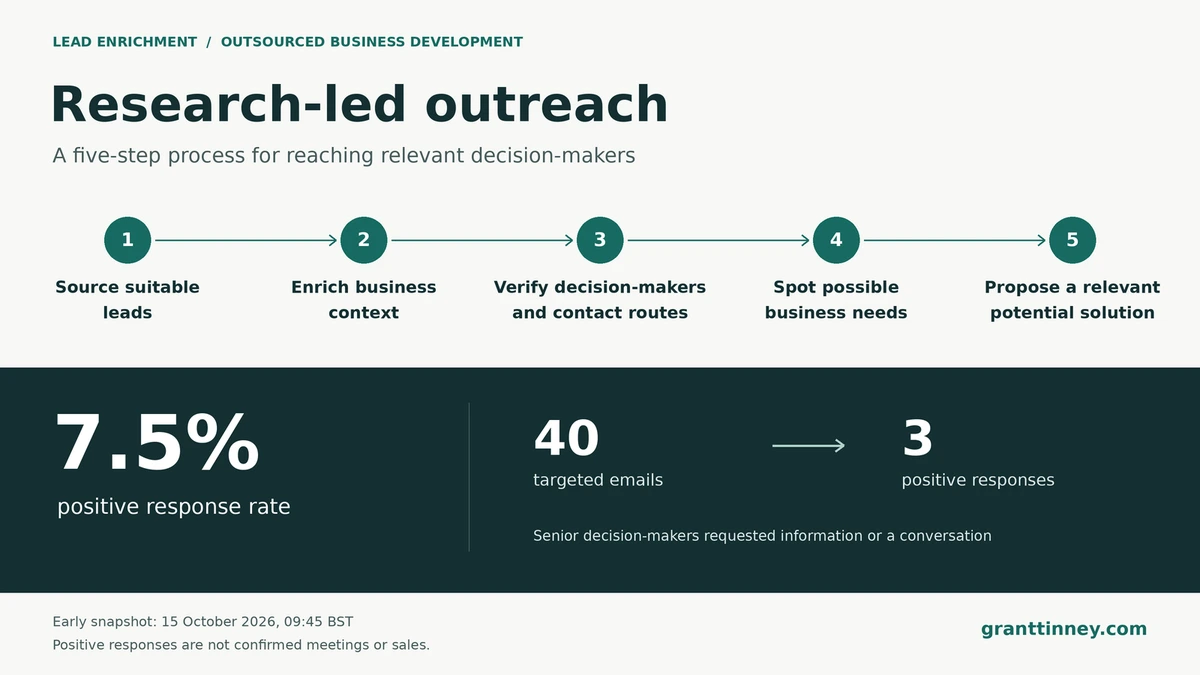
Before sending a cold email, we want to understand why this business belongs on the list, who owns the relevant decision and what might make a conversation useful to them. Lead enrichment should help answer those questions.
A company name and an email address give you a route into an inbox. Adding reliable business context gives you a basis for deciding whether to use it, what to investigate and which potential solution might be relevant.
In a campaign we delivered, we researched a shortlist of around 50 businesses. From 40 targeted emails, three senior decision-makers responded positively and requested further information or a conversation: a 7.5% positive response rate. This was the early snapshot of the initial 40-email test at 09:45 UK time on 15 October 2026. The five-part process below shows how this research discipline can support outsourced business development.
1 Source leads with a clear reason to engage
Start with the commercial problem your service is designed to address. Then define the kinds of businesses for which that problem could matter. Sector, business model, geography, customer base and stage of development can all help narrow the search.
For a consultancy offer aimed at restaurant businesses, for example, the useful starting point might be a defined type of operator and a specific commercial issue. It would be premature to assume every restaurant has the same need.
Company websites, relevant industry directories and event listings can help identify candidates. Each lead should earn its place on the list through a clear fit hypothesis. Record that reason, along with anything that could rule the business out. This makes the list easier to review before time is spent finding contacts.
2 Enrich the business context
For each shortlisted company, build a concise view of what it sells, who it serves, where it operates and what has recently changed. Look at its own website, announcements, published case studies and other relevant public business information.
The purpose is to understand enough to make a sensible commercial judgement. Collecting extra fields has limited value if they will not change the approach or qualification decision.
Keep the source and date beside important findings. Separate verified facts from interpretation, and check whether information is still current. A short, well-sourced account summary is more useful than a long profile containing uncertain claims.
3 Find the decision maker and verify the email route
Map the issue to the person likely to own it. Depending on the business and the proposed work, that could be the founder, chief executive, commercial director or another functional leader. Seniority is useful when it comes with responsibility for the relevant decision.
Check current responsibilities through reliable business sources. Where a named person's business email is publicly available, confirm that the source relates to the correct person and company. A plausible domain pattern alone leaves an address unverified.
If a direct address cannot be verified, use an appropriate published business contact route and keep the uncertainty visible. Avoid personal addresses and unnecessary personal information.
Check earlier contact and related group companies before sending. Record delivery failures separately. A bounce is a reason to review the route; it does not establish that the company rejected the proposition.
4 Look for signals of a possible business need
A useful signal gives you a reason to investigate. It might be a new location, expansion into a market, a product launch, a partnership announcement or recruitment into a relevant team.
Ask what the change could mean commercially. Does it create a new audience to reach, a sales process to build or a partnership opportunity to explore? Then ask what evidence would support that interpretation.
For example, a restaurant group announcing new locations may have questions about local demand and customer acquisition. The announcement alone does not prove that either is a problem or that outside support is wanted.
Keep three things distinct: the observed fact, the possible implication and the question to validate. That discipline helps an approach stay relevant without claiming to know more about the business than the evidence supports.
5 Connect the signal to a potential solution
Once there is a plausible need, define how your experience or service could help. Keep the proposed outcome specific enough for the decision-maker to assess. A focused project should have a clearer purpose than a broad offer to help with growth.
The potential solution could be a review of a sales process, a targeted customer-acquisition pilot or work to develop a particular commercial channel. These are examples to assess against the business's circumstances, rather than services to push into every conversation.
Where there is a need but no permanent hiring plan, a defined paid project may be worth discussing. The scope, expected value and appropriate next step still need agreement.
The research should make it easier to open a useful conversation, with room for the recipient to correct the hypothesis or explain a different priority.
Learn from the first batch before expanding
The campaign sought to open exploratory commercial conversations. The researched shortlist contained around 50 businesses; 40 received an initial email. Four human replies arrived, including three positive next-step responses from senior business leaders. These invited further discussion or requested more information.
Early outreach response funnel
40 initial emails sent → 4 human replies (10%) → 3 positive replies (7.5% of initial emails)
The 7.5% figure uses the 40 initial emails as its denominator, excluding subsequent exchanges and automated replies. It records positive progression towards a conversation, rather than three confirmed meetings. This was a small, selected sample and an early snapshot, with unequal response windows across the two groups sent.
For the next batch, we would review which businesses engaged, whether the intended decision-makers were reached, what the replies revealed about need and what happened next. The sample cannot isolate the effect of any individual tactic. Its value is in helping form better questions and a more informed next test.
Outsourced business development built around relevance
Our outsourced business development offer brings together lead sourcing, company enrichment, decision-maker and contact research, needs analysis, messaging, first-touch outreach and a review of the responses.
A focused pilot starts by agreeing the audience, the proposed service and what counts as a qualified conversation. We would track positive replies, qualified conversations, meetings held, proposals and pipeline separately, with clear next steps for suitable opportunities.
The aim is to establish whether the researched need is real and whether the proposed solution has commercial value. Each campaign needs its own measures and evidence. The early result here is a useful case study, with no promise that another audience or offer will reproduce the same positive response rate.
A practical research checklist
- Why does this business fit the offer?
- Which facts support that view, and how current are they?
- Who owns the relevant decision?
- Is the business email or contact route verified?
- What signal suggests a possible need?
- What potential solution is worth exploring?
- What will count as a commercially useful next step?
Contact us to discuss what this approach could do for your business. We can define a focused pilot around suitable leads, relevant decision-makers and a potential solution worth discussing.