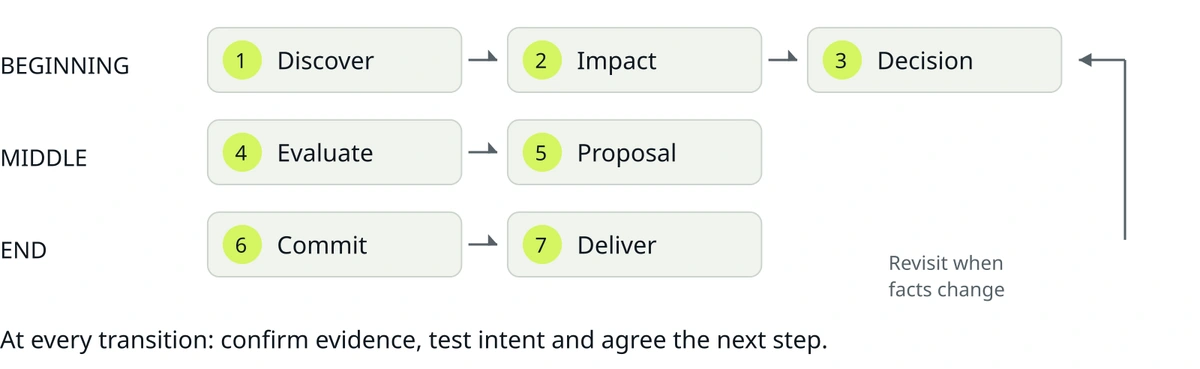
Every good story has a beginning, a middle and an end. A good sales process needs that same sense of direction.
My job is to teach your salespeople how to tell a great story, understand where they and the prospect are in it, and test intentions before moving confidently into the next chapter.
The prospect is the main character. They have something they want to change, people they need to involve and consequences they have to live with. Your salesperson helps them understand their options and make a sound decision. Inventing urgency or hiding weaknesses will damage that work.
The story should explain the buyer's situation in language they recognise: what's happening, why it matters, what better looks like and how they could get there. Ask them to correct it. If they don't recognise themselves, you've misunderstood the story.
Here's how I'd break it into chapters.
The beginning
Chapter 1 Understand the situation
Start with discovery. Give the buyer room to describe their world before deciding what they need.
Ask: What's happening today? What's prompted this conversation? How are you handling it already?
Ready to progress when: The buyer confirms a specific problem or opportunity, explains its context and agrees it's worth exploring.
Agree next: Who will bring the information needed to understand it, and when you'll review it together.
Take a hypothetical deal: Maya runs operations for a restaurant group and is considering scheduling software. She says rota administration is taking managers away from their teams. She agrees to collect a week's time records from two sites. That's a useful next step.
Chapter 2 Establish the business impact
A frustration needs context. How much does it matter compared with everything else the business could work on?
Ask: What does this affect? What happens if you leave it alone? What improvement would justify the cost and disruption of changing?
Ready to progress when: The buyer validates the impact and a meaningful outcome. Record assumptions and gaps alongside any figures.
Agree next: Check the baseline with whoever owns the relevant numbers.
In our example, the records show six hours of rota administration per site each week. Maya wants to recover three. Finance still needs to establish what managers would do with that time; hours released aren't automatically cash savings.
Chapter 3 Understand how a decision happens
Your contact may want change without having the authority or support to make it happen.
Ask: Who will use this, approve it and deliver it? How will funding be agreed? What could stop the decision? Is the target date tied to a real business event?
Ready to progress when: The relevant stakeholders confirm their roles, decision criteria and approval steps. Any missing access remains an open risk.
Agree next: A conversation with the people whose input is needed.
Maya brings in finance, payroll and a site manager. Payroll needs a reliable export; finance needs a credible benefit and an affordable total cost. Those requirements now shape the evaluation.
The middle
Chapter 4 Test whether the solution fits
Make the demonstration or trial answer the buyer's questions.
Ask: What must we prove? What would make you rule this out? How will you judge the result?
Ready to progress when: The agreed tests have been completed, the relevant people accept the evidence and any gaps have an agreed treatment.
Agree next: A review of results against criteria set before the test.
Maya agrees a two-site trial. Managers record administration time and payroll checks the export. The first export fails. The team returns to the technical requirement, fixes the configuration and retests. A convincing demo wouldn't have settled that concern.
Chapter 5 Build a proposal they can decide on
A proposal should bring together what both sides have already established.
Ask: Does this reflect what we've agreed? What's missing? How will this proposal be reviewed internally?
Ready to progress when: The buyer confirms that the scope, price, expected value, responsibilities and unresolved conditions give them what they need to decide.
Agree next: A decision review with the right people and a realistic date.
Maya's proposal includes subscription and implementation costs, training, the rollout plan and the trial findings. It separates measured time savings from benefits still to be demonstrated. Sending the document alone doesn't move the deal forward.
The end
Chapter 6 Confirm the commitment
This is where enthusiasm has to become a clear decision.
Ask: Are you choosing to proceed on these terms? What approvals remain? Who owns each one, and when can it happen?
Ready to progress when: Required approvals and the contractual commitment are complete. Track outstanding legal, procurement or funding steps explicitly.
Agree next: Confirm the decision and arrange the implementation handover.
Maya recommends proceeding, but finance approval is still outstanding. The salesperson records that accurately. Once approval and the agreement are complete, the teams can begin the agreed rollout.
Chapter 7 Deliver the outcome
The buyer's story continues after signature. Set implementation expectations while evaluating the purchase, then carry them through the handover.
Ask: Who owns adoption? What's the starting baseline? When will we review whether this is working?
Ready to progress when: The delivery team and buyer accept the plan, owners and success measures. Keep the outcome open until it's checked.
Agree next: A launch checkpoint and a dated review of results.
Maya and the delivery lead agree training responsibilities and a review after four weeks of use. They will compare rota time with the baseline and check payroll accuracy before deciding whether the intended improvement has been achieved.
Test intentions without forcing the ending
At each transition, ask plainly: “Is this something you want to take further? If so, what would be a useful next step?”
Then look for an action the buyer has willingly agreed to take. “Sounds interesting” leaves you with uncertainty. An agreed data review, stakeholder meeting or evaluation gives you something concrete to work with. A conditional “yes” still needs evidence.
Real deals move backwards, pause and sometimes stop. A new stakeholder may change the criteria. A budget change may remove the reason to act. Revisit the relevant chapter together. A clear no-fit or no-decision outcome is useful too; record why and agree whether any future contact makes sense.
A manager's checklist for the next deal review
Ask your salesperson:
- Can you tell the buyer's story in their own terms?
- Which chapter is the buyer in, and what proves it?
- Which claims are confirmed, and which are assumptions?
- Whose view or approval is still missing?
- What has each side agreed to do next, by when?
- What would make us revisit, pause or stop?
Coach the chapter they're actually in. That gives your team a practical way to tell a coherent story, recognise genuine progress and help the buyer decide what happens next.
Want to work on this with your team? Talk to me about practical sales training and coaching.